Showerhead: Technical Analysis of the "Golden Shower" in Semiconductor Manufacturing
In the high-tech field of semiconductor manufacturing, photolithography machines, etchers, and thin-film deposition equipment are undoubtedly the core devices. However, within these complex pieces of equipment, a seemingly simple yet crucial component - the Showerhead - plays the role of an "invisible champion." This article will delve into the core functions and technical details of the Showerhead in semiconductor manufacturing.
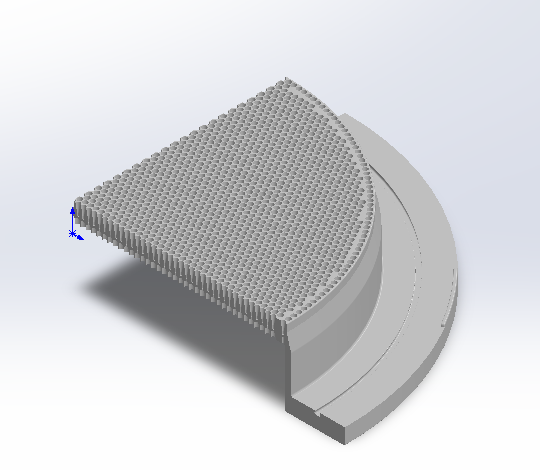
I. Basic Concept and Working Principle of the Showerhead
The Showerhead is a precision circular disc-shaped component installed at the top of the reaction chambers of semiconductor thin-film deposition equipment (such as CVD, PECVD, and ALD) and dry etching equipment.
It resembles a showerhead in appearance, but its functions go far beyond that. The core function of the Showerhead is to uniformly and stably "spray" process gases onto the surface of the wafer below through tens of thousands of tiny holes on its surface. Any minor unevenness in the gas flow during this process can lead to inconsistent film thickness or differences in etching depth, which in turn can affect chip performance or even result in scrap.
The working principle of the Showerhead can be broken down into three steps: gas injection, pressure equalization, and micro-hole spraying. The process gases first enter the pressure equalization chamber above the Showerhead through a back interface. Subsequently, they diffuse and reach pressure balance within the chamber. Finally, they pass through the array of micro-holes on the panel, forming countless fine laminar flows that converge on the wafer surface, achieving uniform coverage across the entire wafer. This process ensures extreme uniformity of the gases on the wafer surface, which is the foundation for achieving nanoscale process accuracy.
II. Core Functions and Roles of the Showerhead
The Showerhead plays multiple key roles in semiconductor manufacturing processes. Firstly, it is responsible for the uniform distribution of gases, breaking down the process gases into countless tiny, uniform gas flows that cover the entire wafer. This function directly determines the uniformity of film thickness and the consistency of etching rates, making it a key factor affecting chip yield. Secondly, during PECVD or plasma etching processes, the Showerhead also serves as part of the process electrode. After being loaded with a radio-frequency power supply, it generates a uniform electric field within the chamber, exciting stable and uniform plasma to ensure reaction uniformity. In addition, the Showerhead influences the gas flow pattern within the chamber through its design, avoiding turbulence and dead zones, precisely controlling the reaction environment, and ensuring that reaction by-products are promptly removed while fresh gases continuously come into contact with the wafer surface. Finally, in cleaning equipment, the Showerhead can uniformly spray cleaning fluids or gases to remove impurities and contaminants from the wafer surface, ensuring cleanliness.
III. Core Structure and Material Evolution of the Showerhead
A typical Showerhead assembly consists of key parts such as a pressure equalization chamber, a gas distribution panel, and a micro-hole array. The pressure equalization chamber is located at the top and is used for the initial mixing of gases and pressure equalization. The gas distribution panel, which has a micro-hole array, directly faces the wafer. The micro-hole array is the direct guarantee of uniformity, with hole diameters typically ranging from 20 micrometers to 6 millimeters and the number of holes reaching from thousands to tens of thousands.
The harsh semiconductor manufacturing environment places extremely high demands on the material selection of the Showerhead. From the initial stainless steel to the current aluminum alloy, and then to advanced ceramic and coating materials for advanced processes, the materials of the Showerhead have continuously evolved. Stainless steel is low-cost but has poor corrosion resistance, making it suitable for early or less demanding processes. Aluminum alloy is lightweight and has good thermal conductivity. Its corrosion resistance is significantly improved through hard anodizing treatment, making it the most mainstream material at present. For advanced processes at 7 nm and below, advanced ceramic materials such as aluminum nitride and silicon carbide, with their characteristics of high-temperature resistance, corrosion resistance, high purity, and high thermal conductivity, have become the first choice for high-end process environments.
In addition, the application of surface coating technologies such as yttrium oxide (Y₂O₃) coatings and diamond-like carbon (DLC) coatings further enhances the corrosion resistance and service life of the Showerhead. Driven by the continuous progress of material science and precision machining technology, domestic enterprises have also made significant progress in the field of the Showerhead. Companies like AMTD, through continuous technological research and development and innovation, have successfully broken the foreign technological monopoly, providing high-quality Showerhead products for domestic semiconductor manufacturing enterprises and effectively promoting the localization process of semiconductor manufacturing.
The Showerhead, as a core component in semiconductor manufacturing, is undeniably complex and important in terms of technology. As chip processes continue to advance, the performance requirements for the Showerhead will become even more stringent. In the future, with the continuous progress of material science and precision machining technology, Showerhead technology will continue to develop, providing more reliable and efficient solutions for semiconductor manufacturing.


